
Have you ever struggled to wrap your head around a tricky concept, whether it’s a math formula, a historical event, or a scientific theory? You read the textbook, watch YouTube tutorials, and still feel like you’re wading through mental fog. I’ve been there, too—staring at pages of dense text, wondering why nothing was sticking. Then I discovered the Feynman Technique, a brilliantly simple method that transformed how I learn. Named after Nobel Prize-winning physicist Richard Feynman, this approach isn’t just for science geeks—it’s a game-changer for anyone looking to master new skills or ideas quickly and deeply.
In this guide, I’ll walk you through the Feynman Technique step by step, sharing practical tips, real-life examples, and a few personal stories to show you how it works. By the end, you’ll have a clear roadmap to learn anything faster, retain information longer, and explain it like a pro. Let’s dive in!
What Is the Feynman Technique?

At its core, the Feynman Technique is a learning method that helps you understand and remember complex ideas by teaching them in simple terms. Richard Feynman, known for his ability to explain intricate physics concepts to anyone, believed that if you can’t explain something simply, you don’t truly understand it. His technique leverages this idea to make learning active, engaging, and effective.
The beauty of the Feynman Technique lies in its simplicity. It’s not about cramming facts or memorizing jargon—it’s about breaking down ideas into their essence and rebuilding your understanding from the ground up. Whether you’re a student, a professional, or just curious about a new topic, this method can help you learn faster and with more confidence.
Why Does the Feynman Technique Work
Before we get to the steps, let’s talk about why this technique is so powerful. Here are a few reasons it stands out:
- It Forces Active Learning: Instead of passively reading or listening, you’re actively engaging with the material by explaining it in your own words.
- It Exposes Knowledge Gaps: When you try to simplify a concept, you quickly realize what you don’t fully understand.
- It Boosts Retention: Teaching something to others (or even to yourself) reinforces your memory and deepens your understanding.
- It’s Universal: From coding to cooking, history to quantum mechanics, the Feynman Technique works for any subject.
I first stumbled across this method when I was trying to learn basic coding concepts. I’d spent hours reading about loops and variables, but they felt like abstract puzzles. The Feynman Technique helped me break them down into something I could explain to my non-techy friend over coffee—and that’s when it clicked. Let’s see how you can do the same.
The Feynman Technique: A Step-by-Step Guide
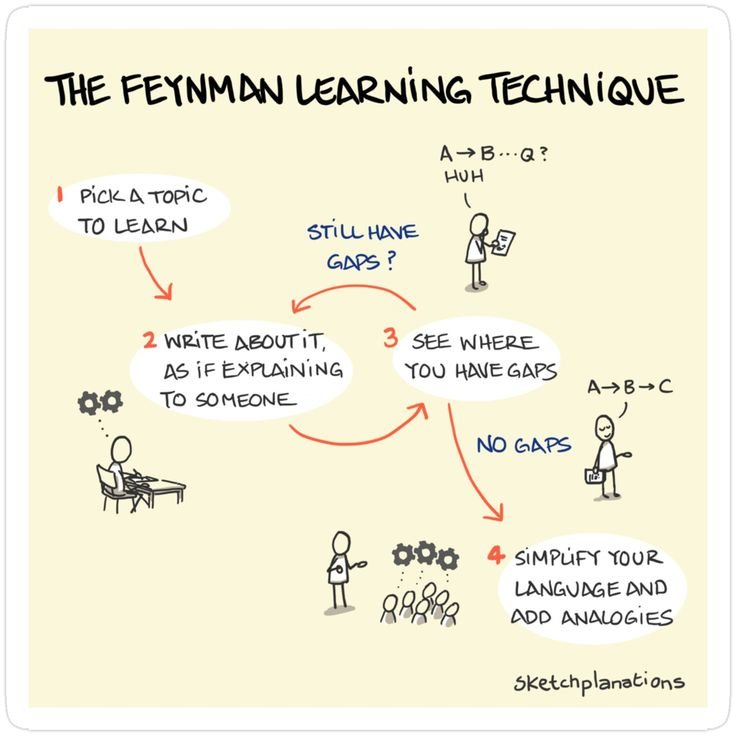
The Feynman Technique has four straightforward steps. Don’t let the simplicity fool you—these steps pack a punch. I’ll guide you through each one, with examples and tips to make it practical and relatable.
Step 1: Choose a Concept and Write It Down
Pick the topic or concept you want to learn. It could be anything from “photosynthesis” to “how to bake a sourdough loaf.” Write the concept at the top of a blank piece of paper or a digital note.
Why This Matters: Naming the concept gives you a clear focus. It’s like setting a destination before you start a journey.
Example: Let’s say you’re learning about supply and demand in economics. Write “Supply and Demand” at the top of your page.
Pro Tip: Start with a concept that’s specific but not too narrow. For example, “photosynthesis” is better than “all of biology,” but “the role of chlorophyll in photosynthesis” might be too granular for a first pass.
Personal Touch: When I started using the Feynman Technique to learn about neural networks, I wrote “Neural Networks” on a sticky note and stuck it to my laptop. It felt like a small commitment to tackle something that had always intimidated me.
Step 2: Explain It Like You’re Teaching a Child
Now, pretend you’re explaining the concept to a 10-year-old. Use simple language, avoid jargon, and focus on the core ideas. Write down your explanation or say it out loud. The goal is to make it so clear that anyone could understand it.
Why This Matters: Simplifying forces you to strip away complexity and focus on what’s essential. If you can’t explain it simply, you probably don’t understand it well enough.
Example: For supply and demand, you might write: “Imagine a lemonade stand. If lots of people want lemonade but there’s only a little, the price goes up because it’s hard to get. If there are tons of lemonade but nobody wants it, the price goes down to get people to buy it. Supply is how much lemonade there is, and demand is how much people want it.”
Pro Tip: Use analogies or stories to make abstract ideas concrete. Kids love stories, and so do our brains—they make concepts stickier.
Personal Touch: I once tried explaining machine learning to my younger cousin, who loves video games. I compared it to teaching a computer to play Mario Kart by showing it thousands of races. Suddenly, it wasn’t just a buzzword—it made sense to both of us.
Step 3: Identify Gaps and Go Back to the Source
As you explain, you’ll likely hit a point where you stumble or realize you’re unsure about something. That’s a good thing! Those stumbles reveal gaps in your understanding. Go back to your study materials—textbooks, videos, or articles—and fill in those gaps.
Why This Matters: Identifying what you don’t know is half the battle. The Feynman Technique shines here because it makes those gaps impossible to ignore.
Example: While explaining supply and demand, you might realize you’re fuzzy on why prices stabilize at equilibrium. Go back to your economics textbook or watch a quick video on market equilibrium to clarify.
Pro Tip: Keep a “gap list” of questions that come up during your explanation. This keeps you focused when you return to your sources.
Personal Touch: When I was learning about neural networks, I got stuck on how “backpropagation” worked. I had to dig into a few dense articles, but once I simplified it as “the computer tweaking its guesses to get better,” the concept clicked.
Step 4: Simplify and Refine Your Explanation
Once you’ve filled in the gaps, revise your explanation to make it even clearer. Cut out any unnecessary details, refine your analogies, and aim for maximum clarity. If you can, test your explanation by teaching it to someone else—or even to an imaginary audience.
Why This Matters: Refining your explanation solidifies your understanding and makes the knowledge yours. Plus, it prepares you to share it with others confidently.
Example: Your revised supply and demand explanation might be: “Supply is how much of something is available, like lemonade at a stand. Demand is how much people want it. If supply is low and demand is high, prices rise. If supply is high and demand is low, prices drop. They balance out where supply meets demand.”
Pro Tip: Record yourself explaining the concept or write it as a blog post (like this one!). Reviewing your explanation later can reveal areas for improvement.
Personal Touch: After refining my neural network explanation, I shared it with a friend who’s a teacher. She didn’t care about the math but loved the idea of a computer “learning like a kid practicing a game.” That feedback helped me simplify even further.
Tips to Supercharge the Feynman Technique
Now that you know the steps, here are some extra tips to make the Feynman Technique even more effective:
- Use Visuals: Draw diagrams or sketches to complement your explanation. For supply and demand, a simple graph with supply and demand curves can make the concept crystal clear.
- Practice Teaching: Find a real person—a friend, family member, or colleague—to explain the concept to. Their questions will sharpen your understanding.
- Iterate Often: Don’t expect to nail the explanation on your first try. Keep refining it as you learn more.
- Apply It Immediately: Use the concept in a real-world context. For example, if you’re learning about supply and demand, analyze gas prices or a local market trend.
- Stay Curious: Approach the technique with a sense of play. Feynman himself was known for his childlike curiosity, which made learning fun.
Personal Touch: One of my favorite moments using this technique was when I taught my mom about blockchain. I compared it to a shared notebook that everyone updates together. Her “aha!” moment was so rewarding—it reminded me why I love learning and sharing knowledge.
Real-Life Applications of the Feynman Technique
The Feynman Technique isn’t just for academic subjects. Here are a few ways you can apply it in everyday life:
- At Work: Need to master a new software tool or explain a project to your team? Use the Feynman Technique to break it down and communicate clearly.
- In Hobbies: Learning to cook a new dish or play a musical instrument? Simplify the steps and teach them to a friend to solidify your skills.
- In School: Struggling with a tough subject like chemistry or history? The Feynman Technique can help you ace exams by ensuring you truly understand the material.
- For Personal Growth: Want to understand mindfulness or financial planning? Teach the concepts to yourself in simple terms to build confidence.
Example: A friend of mine used the Feynman Technique to learn Spanish vocabulary. Instead of memorizing flashcards, she explained each word’s meaning and usage to her dog (yes, her dog!). The act of verbalizing helped her remember words faster.
Common Challenges and How to Overcome Them
Like any method, the Feynman Technique has its challenges. Here’s how to tackle them:
- Challenge: “I feel silly talking to myself or an imaginary kid.”
Solution: Embrace the silliness! It’s part of the process. If it helps, write your explanation as a letter to a friend or record a podcast-style audio. - Challenge: “I don’t know where to start with complex topics.”
Solution: Break the topic into smaller chunks. For example, instead of tackling “quantum physics,” start with “wave-particle duality.” - Challenge: “I keep finding new gaps in my knowledge.”
Solution: That’s the point! Each gap is an opportunity to learn more. Be patient and keep iterating.
Personal Touch: When I first tried the Feynman Technique, I felt awkward pretending to teach a kid. But once I started writing my explanations as if I were chatting with a friend, it felt natural—and way more fun.
Why the Feynman Technique Feels Like Magic

The Feynman Technique feels like magic because it transforms learning from a chore into a creative, empowering process. It’s not about rote memorization or chasing grades—it’s about truly owning the knowledge. When you can explain something complex in a way that lights up someone else’s eyes (or your own), you know you’ve mastered it.
For me, this technique has been a lifeline. It’s helped me tackle topics I once thought were “too hard,” from coding to philosophy. It’s also made me a better communicator, whether I’m presenting at work or helping a friend understand something new. Most importantly, it’s reminded me that learning is a journey, not a race.
Final Thoughts: Start Small, Think Big
The Feynman Technique is a tool, not a miracle cure. Like any skill, it takes practice to get the hang of it. Start with a small concept—something you’re curious about but not overwhelmed by. Maybe it’s how a camera lens works or the basics of yoga. Follow the steps, embrace the stumbles, and watch how quickly your understanding grows.
As you use this technique, you’ll not only learn faster but also gain confidence in your ability to tackle any subject. You’ll start seeing connections between ideas, asking better questions, and maybe even inspiring others to learn with you. That’s the real magic of the Feynman Technique—it’s not just about learning; it’s about sharing knowledge and growing together